
THANK YOU FOR SUBSCRIBING

Gov CIO Outlook Weekly Brief
Be first to read the latest tech news, Industry Leader's Insights, and CIO interviews of medium and large enterprises exclusively from Gov CIO Outlook
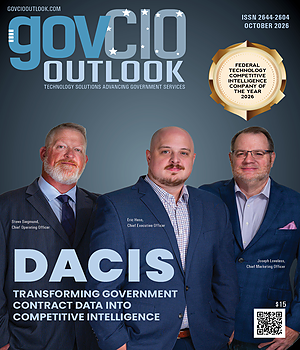
In government contracting, access to information has never been greater. Organizations can search solicitations, track procurement announcements, and identify potential opportunities through an expanding ecosystem of digital platforms. Yet the ability to discover an opportunity is only the beginning of the challenge. The organizations that succeed are those that understand the broader environment surrounding that opportunity, including incumbent positions, acquisition histories, budget priorities, contract relationships, and potential teaming strategies. This distinction has become central to DACIS’s mission. While many platforms focus on making government data accessible, DACIS focuses on transforming that information into competitive intelligence. “Our approach is built around connecting the relationships between contracts, companies, programs, budgets, and historical performance, allowing customers to see the larger story behind government procurement decisions,” says Eric Hess, Chief Executive Officer, DACIS. For three decades, DACIS has served organizations operating across the defense, aerospace, and government contracting sectors. The company has evolved alongside a changing marketplace where competition has increased, new technology companies have entered the federal space, and decision-makers require deeper insight before pursuing major opportunities.
Bryan Mulligan, President and CTO
Transportation infrastructure has always been built for the long haul. Traffic signals, roadside equipment, and communication networks are designed to serve communities for years, sometimes decades. But the future is arriving faster than those systems were built to accommodate, making traditional replacement cycles painfully slow. Vehicles are becoming electric and connected. Autonomous systems are moving closer to reality. New communication standards are emerging, while AI is reshaping how infrastructure is monitored and managed. Yet public agencies cannot simply remove everything in the field and start over whenever new technology appears.


Laura Davis, Co-Founder and Eric Davis, CEO and Co-Founder
For most government affairs professionals, the hardest part of the job was never the analysis. It was everything that came before it: finding the bills, pulling the hearing video, reading across fifty state capitols, and assembling it all into something a client could act on. Done by hand, a multi-state report can take weeks, and by the time it lands, the legislative landscape has often moved. USLege, an Austin, Texas–based policy operations platform and the winner of the Best Legislative Tracking Software of the Year, was built to close that gap. Founded in 2023 by Eric Davis, Laura Davis, and Ben Brewer, the company maintains a live, searchable record of US government across all 50 states and federal, covering bills, regulations, and hearing and floor video, plus select local jurisdictions. “People have done this research the same way for a very long time. Manually find the data, manually aggregate it, manually build the report,” says Davis, CEO and co-founder. “Our clients do it before their coffee gets cold.”
Traffic Management

Emad Elshafei, Ph.D., P.E., PTOE, Chief of Traffic and Transportation, City of Rockville
Artificial Intelligence

Rolland Kornblau, Director of Information Technology, City of San Bernardino
Government Procurement

Joe Moudy, Director of OEM, City of Lubbock
Digital Transformation

Dirk S. Thueson, Assistant Director - IT Infrastructure, Houston Public Works
Digital Transformation

Nicholas Augustine, Assistant Chief, Montgomery County Police, Md

Emergency Management
Julie Corn, Commissioner of Department of Emergency Communications/911, Onondaga County

Civic Engagement
Inez J. Rodenburg, GISP, CGCIO, MBA, Chief Information Officer (CIO), City of Danville
Technology is making benefits administration more automated, personalized, data-driven, integrated, and strategically valuable for businesses.
Electronic voting technology improves election efficiency, reliability, and administrative performance through secure, scalable, and professionally managed digital solutions.
Intelligence, Infrastructure and Responsible Public Service
Our cover story features DACIS, recognized as the Federal Technology Competitive Intelligence Company of the Year 2026. For three decades, DACIS has transformed complex government contracting data into connected competitive intelligence. By associating contracts, companies, programs, budgets and historical performance, it gives organizations the broader context needed to evaluate opportunities, understand market dynamics and make more informed strategic decisions. Applied Information Inc., awarded Top Traffic Infrastructure Management Solution 2026, helps transportation agencies modernize existing infrastructure through connected traffic systems, cloud technology, wireless connectivity and adaptable hardware.
Nicholas Augustine, Assistant Chief at Montgomery County Police, Md., shares insights on leading digital transformation by aligning technology with organizational needs, employee engagement, community trust and measurable outcomes.
Dirk S. Thueson, Assistant Director - IT Infrastructure at Houston Public Works, explores the actual realities of modernization. He stresses the need to begin with foundational work, including system inventories, dependency mapping, data governance, cybersecurity and workforce preparation, before pursuing advanced functions. His message is clear, modernization must create a secure and scalable foundation for what comes next.
Together, these perspectives reinforce a central theme: the future of government technology will be shaped by organizations that connect insight with execution. We invite readers to review this edition and consider how stronger intelligence, responsible stewardship and purposeful modernization can advance public-sector outcomes.