

THANK YOU FOR SUBSCRIBING

Gov CIO Outlook Weekly Brief
Be first to read the latest tech news, Industry Leader's Insights, and CIO interviews of medium and large enterprises exclusively from Gov CIO Outlook

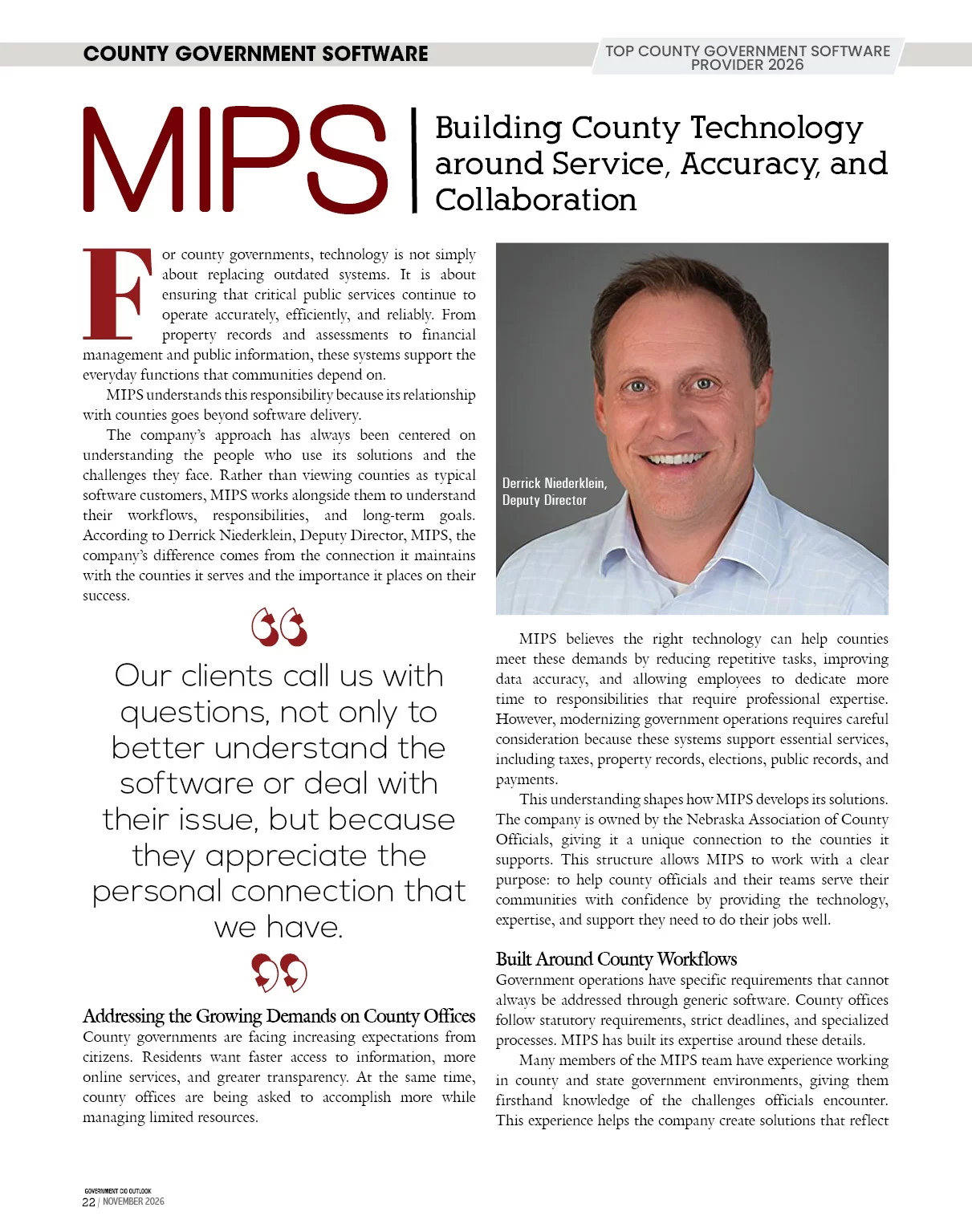
 Derrick Niederklein, Deputy Director
MIPS understands this responsibility because its relationship with counties goes beyond software delivery.
The company’s approach has always been centered on understanding the people who use its solutions and the challenges they face. Rather than viewing counties as typical software customers, MIPS works alongside them to understand their workflows, responsibilities, and long-term goals. According to Derrick Niederklein, Deputy Director, MIPS, the company’s difference comes from the connection it maintains with the counties it serves and the importance it places on their success.
Addressing the Growing Demands on County Offices
County governments are facing increasing expectations from citizens. Residents want faster access to information, more online services, and greater transparency. At the same time, county offices are being asked to accomplish more while managing limited resources.
MIPS believes the right technology can help counties meet these demands by reducing repetitive tasks, improving data accuracy, and allowing employees to dedicate more time to responsibilities that require professional expertise. However, modernizing government operations requires careful consideration because these systems support essential services, including taxes, property records, elections, public records, and payments.
This understanding shapes how MIPS develops its solutions. The company is owned by the Nebraska Association of County Officials, giving it a unique connection to the counties it supports. This structure allows MIPS to work with a clear purpose: to help county officials and their teams serve their communities with confidence by providing the technology, expertise, and support they need to do their jobs well.
Built Around County Workflows
Government operations have specific requirements that cannot always be addressed through generic software. County offices follow statutory requirements, strict deadlines, and specialized processes. MIPS has built its expertise around these details.
Many members of the MIPS team have experience working in county and state government environments, giving them firsthand knowledge of the challenges officials encounter. This experience helps the company create solutions that reflect actual county workflows rather than forcing offices to adapt to technology that was not designed for them.
Expanding Support beyond Software
Over time, MIPS has expanded its services based on the changing needs of county offices. One area of growth has been appraisal services, where counties have faced challenges related to staffing, workload, and access to specialized expertise. The company has developed teams that can provide additional support in these areas.
Education has become another important part of the company’s relationship with customers. Through its customer experience team, MIPS provides software support while also helping counties improve processes and understand how technology can support their daily responsibilities. The company also conducts training sessions and seminars to help county teams share knowledge and maintain consistency across different offices.
A Team Focused on Relationships
For MIPS, success is closely tied to the people behind the technology. Niederklein believes that the company’s culture and the dedication of its employees play an important role in the experience customers receive.
“Our clients call us with questions, not only to better understand the software or deal with their issue, but because they appreciate the personal connection that we have,” says Niederklein.
As MIPS continues to grow, the company is working toward helping counties create more connected environments where information can move efficiently between departments. Its future direction includes continuing to refine services and support counties as technology evolves.
 MIPS has been named Top County Government Software Provider for 2026, highlighting the company’s ongoing work in delivering specialized solutions and uniquely personal support for county governments.
With an expanding team and broader capabilities, MIPS continues to build its role as a trusted technology partner for Nebraska counties, combining government expertise with practical solutions designed around the people who rely on them.
That combination of county knowledge, personal service, long-term relationships, and practical technology is what continues to distinguish MIPS.
Because for MIPS, success is not simply measured by the software it delivers. It is measured by how well the counties it serves are able to succeed.
What Do County Government Software Providers Help Local Governments Manage?
County Government Software Providers develop technology that supports the daily responsibilities of county offices. Their solutions can cover financial management, property assessment, tax administration, public records, geographic information systems and citizen communication. These functions require accurate information, reliable processes and compliance with government regulations. Software designed specifically for counties can reduce repetitive administrative work and help departments share information. It also supports public employees who must manage statutory deadlines while maintaining essential services for residents and businesses.
How Does MIPS Develop Software Around the Needs of County Officials?
MIPS operates among County Government Software Providers with a focus on Nebraska counties. Owned by the Nebraska Association of County Officials, the company maintains close relationships with the government offices it serves. Many members of its team have experience working in county and state government, giving them firsthand knowledge of public-sector responsibilities. MIPS uses that understanding to develop software around existing workflows and statutory requirements. Its integrated solutions support financial management, property assessment, public records, GIS and communication, helping county employees manage interconnected responsibilities.
Why Is Integrated Software Important for County Government Operations?
County Government Software Providers can help local governments overcome problems created by disconnected systems and repeated data entry. Financial records, property information and public records often serve different departments but may depend on related information. When systems work together, employees can access relevant data without repeatedly transferring it between applications. Integration can also improve consistency and reduce administrative delays. For county offices managing limited resources, better information sharing allows employees to spend more time addressing responsibilities that require their expertise and judgment.
What Should Counties Consider When Selecting Government Software?
Choosing the right software for county government involves more than comparing features. Counties need systems that meet their legal obligations, support reporting requirements and fit the way their departments work. When evaluating County Government Software Providers, they should also consider the support available during implementation, employee training and everyday operations. Accurate recordkeeping and dependable public services are essential, while systems that connect departments can reduce duplicate work and make reporting easier. Providers with experience in local government may also have a better understanding of the day-to-day challenges county officials face.
How Does MIPS Support Counties Beyond Its Software Solutions?
MIPS extends its role among County Government Software Providers through specialized services and ongoing customer education. Alongside its software ecosystem, the company offers appraisal services, GIS support, mass printing, document solutions and website services. These capabilities help counties address operational needs that extend beyond technology alone. Its customer experience team provides software assistance and helps employees improve their processes. MIPS also conducts training sessions and seminars, giving county teams opportunities to strengthen their knowledge and maintain consistency across offices.
How Can County Government Software Improve Public Service Delivery?
County Government Software Providers support public service delivery by helping government employees manage information accurately and complete administrative tasks efficiently. Digital workflows can reduce manual processing, while connected records make information easier to retrieve across departments. These capabilities become particularly valuable when residents expect timely responses, accessible public information and reliable government services. By improving the systems behind everyday operations, counties can strengthen internal coordination and make better use of available resources. The broader objective is to help public employees serve their communities with greater consistency and confidence.
Company
MIPS
Management
Derrick Niederklein, Deputy Director
Description
MIPS helps Nebraska counties manage critical government operations through integrated software solutions, deep industry expertise, and strong customer relationships. By combining technology, training, and specialized services, MIPS supports counties in improving accuracy, efficiency, and public service delivery.


