
THANK YOU FOR SUBSCRIBING

Gov CIO Outlook Weekly Brief
Be first to read the latest tech news, Industry Leader's Insights, and CIO interviews of medium and large enterprises exclusively from Gov CIO Outlook
Federal civilian agencies manage services that shape everyday life, from healthcare and transportation to public safety and financial assistance. Their missions depend on timely information, reliable systems and decisions that respond to public needs. AI can strengthen these functions, but results require more than introducing software. Agencies need to connect algorithms with mission data, established workflows, secure infrastructure and accountable oversight. Booz Allen Hamilton Inc. (NYSE: BAH) works with federal civilian agencies to translate AI capabilities into tools supporting public services and government operations. Its work spans healthcare, homeland security, law enforcement, transportation, financial services, energy and environmental missions. By combining AI engineering with data, cloud and cybersecurity, the company helps agencies integrate technology into the systems employees and citizens use. Designing Tools for Frontline Agency Needs Civilian agencies face different operational demands, making AI applications dependent on the missions they support. Booz Allen develops cognitive search tools, predictive models and computer vision applications for government use. These capabilities make information easier to find, reveal emerging risks and strengthen analysis involving substantial volumes of data. AI models can help researchers examine patterns related to infectious disease, foodborne illness and opioid-related harm in healthcare and public health. Predictive analytics help identify populations at higher risk for complications, allowing for earlier intervention and more informed resource allocation. Navigating complex medical and government information is made easy by NLP and cognitive search.
Curtis L. Bartell, CEO and Peter W. Dwyer, Chief Federal Programs Officer
Government agencies operate in environments where disruptions can affect their essential services. When emergency management, continuity and security are managed separately, decision-makers often lack a complete picture of organizational risk, making it harder to prioritize threats and allocate resources. Drawing on 36 years of experience and team members’ federal backgrounds, Covenant Park Integrated Initiatives, Inc. applies a structured risk methodology rooted in each organization’s mission, essential functions and dependencies. This gives leaders a consistent enterprise-wide view of competing threats, helping them understand how risks affect mission delivery and direct limited resources toward the most consequential areas. “We level the risk playing field in an organization so that from the top down, resources can be applied where the risks are higher,” says Curtis L. Bartell, CEO. Making Risk Management Work in Practice Covenant Park helps government and commercial clients build resilience programs from scratch, strengthen existing ones or address specific gaps with subject-matter expertise. Its work spans business continuity, emergency management, reconstitution, devolution and critical infrastructure protection. The company connects these disciplines to enterprise-wide risks and the essential functions that sustain each organization’s mission.

Public Safety

Tina Rodgers, Director Safety and Loss, San Manuel Band of Mission Indians.
Civic Engagement

Alvaro Valdez, Assistant Management Services Director, City of Burbank
Law Enforcement

Al Gardner, Executive Director of Public Safety, City and County of Denver
Artificial Intelligence

Michael D. Shinton, P.E., Director of Codes and Community Planning, Horsham Township
Startups

David E. Sems, Director of Communications and Technology, City Of Strongsville


Smart City
Vedrana Milakovic, MBA, CCS, CES, CZS, Director of Planning and Economic Development, Citizen Potawatomi Nation
AI enhances intellectual property management in government agencies through automated analytics and oversight, supporting innovation protection, efficiency and collaboration.
Intelligent disaster readiness platforms help government agencies predict risks, coordinate emergency responses, protect communities and strengthen public safety through data-driven decisions.
Institutional Readiness for Government Technology Advances
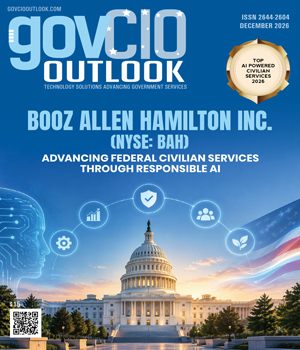
Booz Allen Hamilton Inc. (NYSE: BAH), earns recognition as Top AI Powered Civilian Services 2026 for advancing federal civilian missions through responsible AI. The company combines AI engineering with data, cloud computing and cybersecurity to benefit the healthcare sector, homeland security, transportation and other fields. The activities result in cognitive search tools, predictive analytics solutions and computer vision solutions that enhance information search, risk detection and analysis. Some examples include aiSSEMBLE, an open-source solution that standardizes the creation and deployment of models, and proper governance that ensures privacy, fairness and accountability. The company helps agencies make AI actionable by connecting algorithms to mission data and processes.
Covenant Park Integrated Initiatives, Inc., the Top Government Resilience Strategy and Risk Management Service 2026, leverages its extensive experience in federal operations. The company uses a risk management approach that integrates emergency management, continuity and security in a structured and mission-driven way. It focuses on critical functions, equalizes risk comparisons throughout the organization and enables the transfer of knowledge so that clients can maintain their programs independently.
According to Darren Dang, Chief Technology Officer at the Orange County Employees Retirement System, one must work on the Agency Gap by defining purpose, credible knowledge, visible judgment, effective governance and bounded delegation before increasing AI agency. Ike Canady, GIS Director at the County of Onslow, notes that the use of technology is only valuable when there is an environment of trust and accountability, allowing the staff to have ownership of results so that GIS becomes the basis of decision-making.
Leadership that builds institutional capacity before scaling tools remains essential for accurate service, public trust and adaptive government. Explore the edition further to examine these perspectives and the concrete practices shaping resilient, accountable public technology.