

THANK YOU FOR SUBSCRIBING

Gov CIO Outlook Weekly Brief
Be first to read the latest tech news, Industry Leader's Insights, and CIO interviews of medium and large enterprises exclusively from Gov CIO Outlook
A featured contribution from Leadership Perspectives: a curated forum reserved for leaders nominated by our subscribers and vetted by the Gov CIO Outlook Advisory Board.

Introduction
John M. Taylor
As complex as it may seem, there is a simple definition: systems perform, programs maintain, and models predict changes that alter system performance. A common problem occurs when organizational identity is confused with operational function. What an organization, person, facility, technology or other asset does normally does not necessarily define its function when conditions change. The Life-Safety Systems Doctrine begins with a simple premise: it is not what an asset is during normal operations, but what it becomes for the purpose of Life-Safety. A worker may become a first responder, a manufacturing facility may transition to an inoculation center, and an accounting training database may convert to a disaster accountability program.
Recognizing what an existing asset can become requires a different mindset. A Life-Safety Mindset evaluates documented capabilities and how they can be aligned, linked, and applied to accomplish the mission. Framing influences what is perceived and the decision path that follows. When constraints are encountered, the choice may be to implement the rules within those constraints or circumvent the rules because of them.
The Problem
One of the most complex open systems is the individual human being, yet complexity can be simplified. Like other open systems, the individual operates within mission, objectives, parameters, conditions and constraints. What makes the individual different is autonomy. No two people are exactly alike; therefore, alignment and linkage with other individuals, organizations and systems are not automatic.
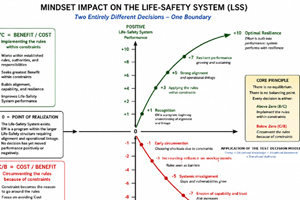
Mindset influences how mission, objectives, parameters, conditions and constraints are framed, interpreted and justified. This creates two decision paths. benefit/cost (B/C) implements the rules within constraints. cost/benefit (C/B) circumvents the rules because of constraints. Justification can alter perception until an actual C/B path is perceived as B/C. The facts have not changed; their perception has.
Autonomy provides the ability to decide, but it does not make every decision correct. Doing what is expected right the first time requires decisions to remain aligned and linked with what governs the system. W2H asks why, what and how before determining who. The Balanced Scale Principle evaluates interests, requirements, benefits and costs rather than merely justifying a desired outcome.
People remain one of the greatest influences on system performance. Mindset cannot be known with certainty at any given time; therefore, alignment and linkage must be intentionally established and maintained.
The Doctrine
The Life-Safety Systems Doctrine does not remove individual or organizational autonomy. It establishes the rules by which autonomous assets align and link to accomplish the Life-Safety Mission. Mission, objectives, parameters, conditions and constraints operate within command, control and 360-degree communications to establish what is expected.
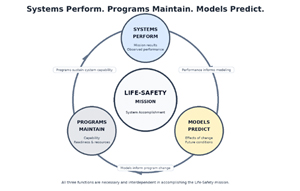
Systems perform the mission. Programs maintain the documented capabilities necessary for performance. Models predict how changing conditions may affect performance. Each has a separate but interdependent function. Confusing them creates the expectation that programs perform rather than maintain required System capabilities.
As illustrated in Figure 1, systems, programs and models remain separate but interdependent functions, each contributing differently to accomplishment of the Life-Safety Mission.
Conditions also determine when authority changes. The TEST Decision Model establishes transitional authority: timing + educational knowledge + situational awareness = transitional authority. TEST identifies the authority available under the conditions existing when a decision is made. Mindset and framing influence how that authority is interpreted and exercised; they do not establish it.
Figure 2 illustrates how mindset and framing influence the application of transitional authority and the resulting B/C or C/B decision path affecting Life-Safety System performance.
The objective is not conformity, but alignment and linkage. Individuals and organizations remain autonomous while documented capabilities are intentionally aligned and linked with the functions necessary to accomplish the mission. When conditions change, the asset may remain the same, while its function, application and authority within the system change.
Why It Matters
Life-Safety Systems depend on people making decisions under changing conditions, often with limited time and incomplete information. When organizational identity, individual interests or established programs become the focus, the mission can become secondary.
The required capability may exist but remain unrecognized, unaligned or unlinked because it is viewed only through its normal function. A program may be maintained exactly as designed while the larger system fails to perform what is expected. Emergencies and disasters do not eliminate autonomy, rules or constraints; they change the conditions under which they are applied.
Its Application
Application begins with the mission, not the organization or asset expected to perform it. W2H establishes why action is required, what must be accomplished and how before determining who possesses the documented capability. TEST identifies the transitional authority available to act. The Balanced Scale assesses interests, requirements, benefit, and costs.
The result may require no new asset or Program. It may necessitate recognizing an existing capability and intentionally aligning, linking, and applying it differently as conditions change. The assets remain autonomous; their function within the Life-Safety System changes.
Conclusion
Systems do not perform because programs exist, nor do people or other assets become useful simply because capabilities are documented. Systems perform when existing capabilities are recognized, intentionally aligned, linked and applied to accomplish the mission, most importantly the protection of people.
Programs maintain those capabilities. Models predict how changing conditions may affect their application and performance. People remain the influencing factor because mindset, framing, and justification affect the decisions that follow. When the mission remains the focus, rules establish the boundaries, and capabilities are applied according to changing conditions, the complex becomes simpler: systems perform. Programs maintain. Models predict.


